Showing posts with label dal. Show all posts

Thursday, July 1, 2010

Thursday: It's been so long, beans


Long beans cooked with mustard seeds and red pepper, served with toor dal and basmati rice.

It's been quite a while since long beans last appeared on the blog - but it'd be more often if we could find them more frequently!  These relatives of black-eyed peas have a deep, delicious flavor with less of the harsh greennness of green string beans, and have an almost dry but chewy texture.  In this recipe from Madhur Jaffrey's World of the East, they were flavored with asafoetida, mustard seeds, cumin, toasted urad dal, dried red chilies and cayenne pepper, and at the end of cooking we added grated coconut.  If you have those ingredients on hand, you could try this preparation with normal green beans too.  We really loved this dish.

Saturday, June 19, 2010

Saturday lunch: Saag story

 
Saag and hulled moong dal, served with basmati rice.
We're a little shocked that we haven't made saag for an entire year, since it's a classic and one of our favorite comfort foods.  It can take many forms: made with spinach (as we did here) or some other local greens; pureed or merely cooked down to a soft texture; studded with paneer, meat, or something more unconventional, like tofu.  This spinach had a particularly deep, rich flavor - it seemed to be a different variety than the usual one you find in salad mixes, as it had slightly lance-shaped, angular leaves.
Dessert was this beautiful bowl of black raspberries (not the same as blackberries), which are so soft and easily ruined in transit that they are hard to find in grocery stores, but are widely available at the farmer's market during this season:

Sunday, May 16, 2010

Sunday: Radical radishes


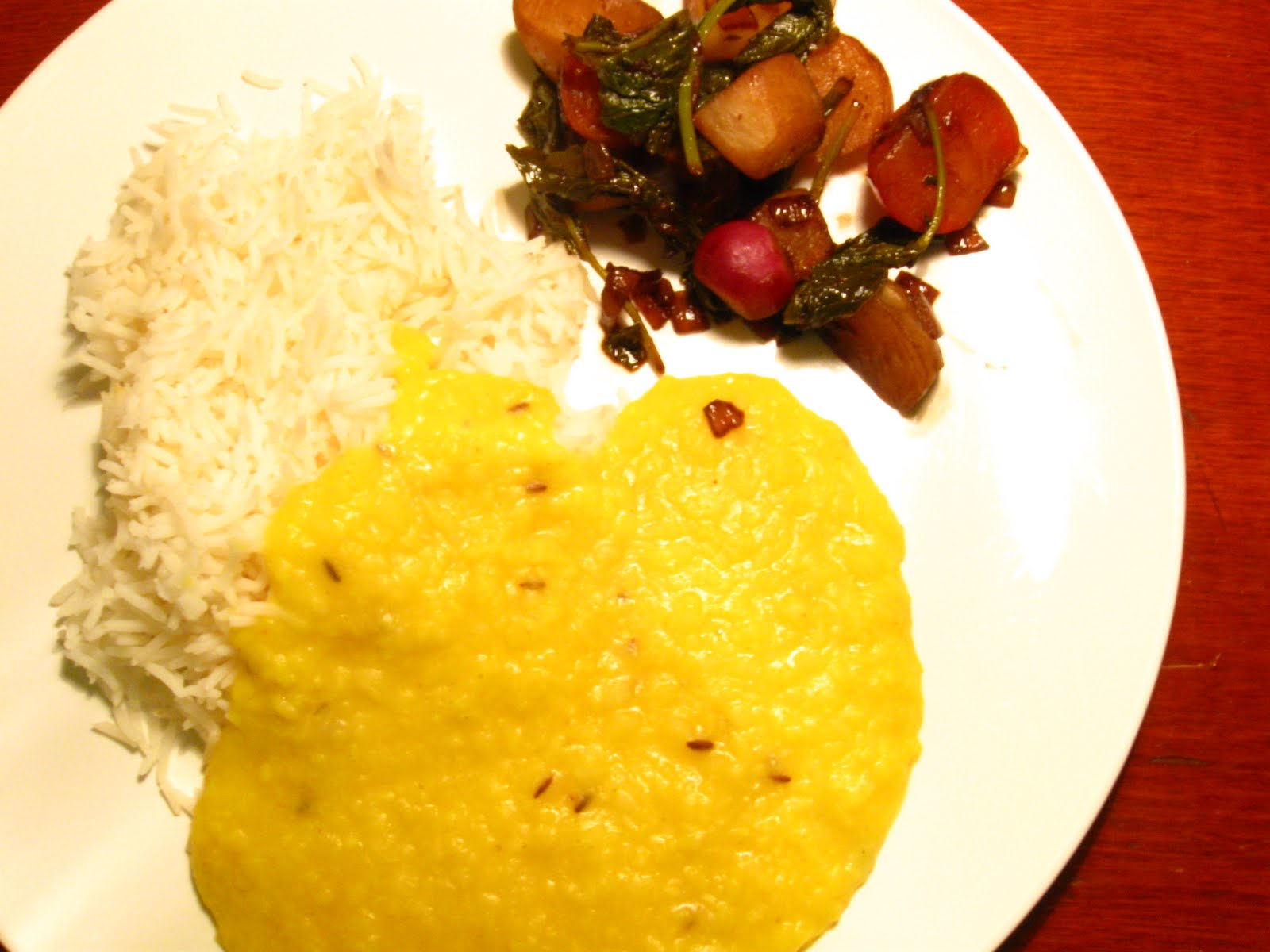
Braised heirloom radishes with moong dal on basmati rice.

These mixed heirloom radishes were too pretty not to buy: the bunch contained red, purple, pink and white small radishes, plus a few that were light brown and had a rough texture, like a "golden russet" apple.  We didn't realize until now that radishes are actually a spring vegetable.  To tone down their spiciness, we braised the radishes along with their tops, which were in good shape.  Balsamic vinegar is not a traditional Indian ingredient but this still worked well as a vegetable dish to pair with moong dal.

Monday, April 12, 2010

Monday:


Potatoes with whole spices and sesame seeds and mung dal.

You might be saying, "But, faithful bloggers! Doesn't mung dal look more like this?" Well, on our recent Jackson Heights shopping spree we picked up this pack of mung dal, which was missing its green hulls and which had a brighter yellow color overall. To be honest we have not been able to sort out what's going on there, but they are definitely skinless, and maybe something has been done to change the color (like a light roasting). Regardless, they have a slightly less distinctive but definitely still tasty flavor, they're a bit quicker-cooking, and they have a creamy texture since they're lacking their skins.

Monday, March 29, 2010

Monday: Brief concession to the agroindustrial complex


Chana dal with cucumbers.

Yes, you've seen this before - but it's a meal that still tastes good even if you have to use shink-wrapped, industrial cucumbers.

Tuesday, February 23, 2010

Tuesday: Mystery Dal


Mooth beans on brown rice.

Mooth beans are small brown beans, smaller than even mung beans and rather elongated in shape. For our Boston-area readers, we note that mooth beans are the main legume in the dal at Punjabi Dhaba. (For others, Punjabi Dhaba was our favorite Indian restaurant in the Boston area.)

The identity of this legume was actually the source of much debate back when we were living in Somerville. At that point we already had most of the basic dals - chana, mung, urad, toor, masoor - on our shelf. But none of them resembled the legume in the Punjabi Dhaba dal. We argued for months or more, pretty much any time that we went to the Dhaba (which was often), but we couldn't agree. They were far too small to be toor dal, but the wrong color and shape for mung beans.

One day, as we were shopping at our local Indian grocery store, we noted a new legume on the shelf - mooth beans. We realized immediately that mooth must be the mystery legume in the Dhaba dal. There ended the bitter debate.

Mooth beans can reliably be found in Indian groceries in New York, and are probably easier to acquire in Boston and elsewhere these days. We prepared them according to our standard dal recipe, but we did pre-soak them for several hours to speed the cooking a bit.

Thursday, February 11, 2010

Thursday: Mung Dal and Pickles


Mung dal on brown rice with carrot-mustard seed salad and local pickles.

We've blogged about mung dal before - this is one of our standby dal preparations, taken from Madhur Jaffrey's Invitation to Indian Cooking. Here, we served the dal with rice, pickles, and a salad of grated carrots and mustard seeds. (Mustard seeds must be toasted in oil until they pop or else they have almost no flavor.) The wax bean pickles were recently obtained from Norwich Meadow Farms, and the cucumber pickles were purchased from Rick's Picks at the Union Square greenmarket. Both are highly recommended.

Since this dal recipe is so simple and versatile, we feel compelled to share it with you, faithful readers:

Moong Dal

1.5 c moong dal (hulled and split)
2 cloves garlic, peeled
2 slices peeled fresh ginger, 1 inch square and 1/8 inch thick
1 tsp chopped cilantro
1/2 tsp ground turmeric
1/4 - 1/2 tsp cayenne pepper
1.5 tsp salt
1.5 tbsp lemon juice
3 tbsp vegetable oil or usli ghee
pinch ground asafetida
1 tsp whole cumin seeds
lemon or lime wedges

Clean and wash the dal thoroughly. Put the dal in a heavy-bottomed 3- to 4-quart pot, add 5 cups water, and bring to a boil. Remove the froth and scum that collects at the top. Now add the garlic, ginger, parsley, tuermic, and cayenne pepper. Cover, leaving the lid very slightly ajar, lower heat, and simmer gently for about 1.5 hours. Stir occasionally at first, and more frequently toward the end to prevent the dal from sticking on the bottom of the pot. When the dal is cooked (it should be thicker than pea soup), add the salt and lemon juice.

In a 4- to 6-inch skillet or small pot, heat the oil or ghee over a medium-high flame. When the oil is hot, add the asafetida and cumin seeds. As soon as the asafetida sizzles and expands and the cumin seeds turn dark (this will take only a few seconds), pour the oil and spices over the dal and cover immediately. Let sit for a minute or so and then stir thoroughly before serving.

Notes:

1. This recipe works for mung/moong dal, toor/toovar dal, masoor dal, and urad dal. Urad and moon dal are available with or without their hulls; hulled might be preferable, but you can actually use either in this recipe.

2. Serve the dal with rice and lemon or lime wedges. It's best to have something to go with the dal, like a vegetable dish and pickles. (Pickles are traditionally used to add a salty crunch to an otherwise mushy meal.)

Wednesday, February 3, 2010

Wednesday: Bringing it dal back home


Chana dal with cucumber.

This recipe is an old favorite of ours - another filling dish that can be made when quality vegetables are sparse. Strictly speaking, it should be made with bottle gourd (dudhi or lauki), which is easy enough to come by if you frequent the Indian market. Cucumber makes an adequate substitute, however, and that's what we used here.

The recipe comes from Madhur Jaffrey's World of the East, one of our first cookbooks.

Monday, November 30, 2009

Monday: 'Tis the Season


Mung dal on basmati rice.

Yes, 'tis the season...for dal! In the winter months, when fresh local produce is spare, we turn to dal and other dried legumes more often. We've already blogged about the quick-cooking masoor dal and toor dal with green beans, but mung dal is yet another favorite of ours. Mung dal, the split form of green mung beans, takes about an hour to an hour and a half (almost completely unattended), like toor dal.

One of these days we'll post a more comprehensive introduction to dal, so stay tuned...

Saturday, October 24, 2009

Saturday dinner: Broccoli rabe with Indian flavors


Indian broccoli rabe with tomato-flavored masoor dal and basmati rice.

This Mahanandi broccoli rabe recipe pairs the bitter greens with potato and peas - a common treatment of vegetables with a bite in Indian cooking. It makes sense: the potato adds starch and moderates the bitterness, and the peas add bursts of sweetness.

For a side dish, we made a little masoor dal. Masoor is a light pink legume when dry, though as it cooks it turns a pleasant warm orange. Because it is shelled it cooks very quickly - as little as fifteen minutes - so it can serve as a convenient quick protein for a vegetable-based meal.

Monday, September 28, 2009

Monday: Dal, with special guest chef


Toor dal with tomato and green beans.

As the seasons change, the menu here at D4SA changes in turn: here we have the first dal of the fall. In brief, dal refers to any of a number of split lentils in Indian cuisine. As anyone who has seen the dal shelf at our apartment surely knows, that number is rather large. We typically make a lot of dal in the wintertime, as it's a bit too heavy for the heat of summer, and green veggies aren't as easy to come by in the colder months. Stay tuned to learn more about the universe of dal...

This particular dish is toor (sometimes called toovar/tuvar/arhar) dal - which is actually dried, split yellow pigeon peas. It's flavored with mustard seed, lemon juice, brown sugar (jaggery if you have it), cayenne, fenugreek, cumin, turmeric, ginger, and cilantro.

Our enthusiastic guest sous chef Laura chopped the green beans precisely to specifications.


Laura, with the fruits of her labor